Traditional search
1Developer launch page
2Property portal listing
3Map and neighbourhood guide
Pages to visit
EcoWorld AI Marketing Masterclass · 28 July 2026
How to show up in AI answers. And the human-and-AI team that keeps you there.
Faisal Hourani
Which new launch near an MRT is best for a family with young children?
Before we start
Think of the last big thing you bought. A car. A school. A holiday.
Most of us asked an AI first. And it changed what we looked at next.
The correction
Write it once. Keep it true forever.
A couple with a toddler asks which new launch near an MRT would suit them. You go and ask the same thing yourself. Your project does not come up.
You dig. Every page you own says “steps from the MRT.” Nobody says how many minutes. And for this family it is not a commute question. It is a pram question. Eight minutes covered and flat is a different building from eight minutes across a main road in the sun.
So you write one line. Eight minutes on foot, measured on this date, and here is the route.
Someone puts their name on it before it goes live. If those eight minutes are wrong, that is not a typo. It is a claim about a home.
Then you ask again. And look where it ends. Right back at the start.
Part 1 · Look at the answer
Traditional search
AI answer
“Start with these three launches. One is closer to rail; another has larger family units…”
Simplified buyer-facing view. Engines and modes differ.
The hole in the middle
A search pattern is not a prompt log. Someone turning up is not a recommendation.
People used to type “condo KL.” Now they type whole sentences. That tells you they want an answer, not a list. And this is Google data. Nobody can see ChatGPT prompts. Not you. Not me.
Here is the hole. You cannot see the answer. Not who got named. Not what got cited. Not what got said about you.
Then somebody lands on your page from ChatGPT. That is real, and it is named. But it does not tell you how often you showed up, or what they asked.
So you go and look. That is the whole trick. There is no clever tool. You ask, and you write down what came back.
The test we actually run
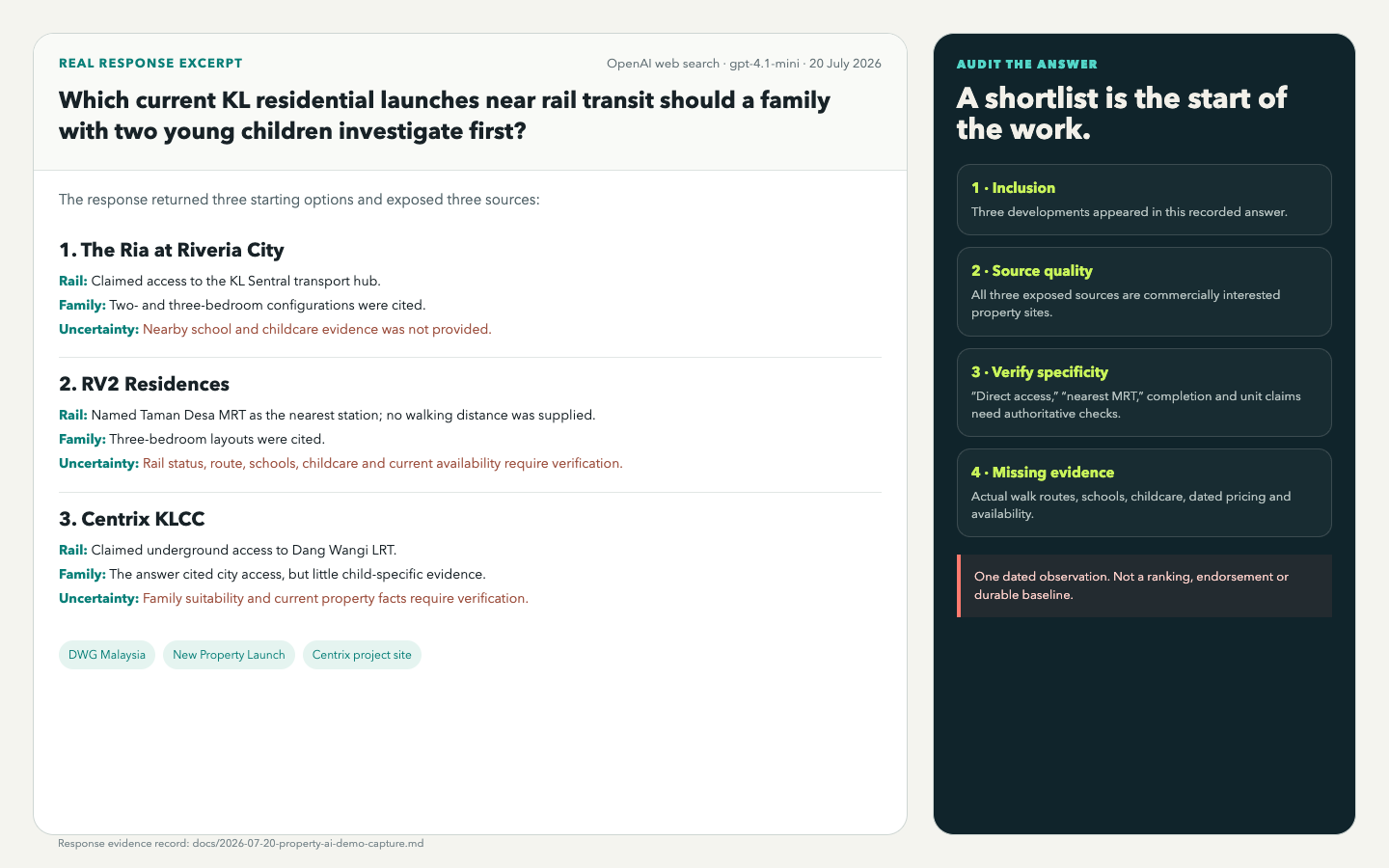
One observation—not a permanent ranking.
Run this one yourself
I'm looking at [YOUR PROJECT] in [AREA]
for a family with young children.

What can you tell me about it?

Then answer three more things:

1. Which sources did you use, and do any
   of them have something to sell?

2. What did you tell me that you could not
   verify from a primary source?

3. What would this family still need to know
   that you cannot answer?
Turn web search on. Write down the date. One answer is an observation, not a ranking.
Four different wins
Do not squash four questions into one number.
Were you in the answer at all? That is the first gate. Most brands have never once checked.
Did anyone actually come? Different question. Different number. Different fix.
Did they do anything once they got here? Or did they look once and leave?
Did anyone enquire? That is the only one that pays for anything.
We changed the scoreboard
We changed the scoreboard before changing the strategy.
On one of my own websites, more people arrived from AI than from Google search
An AI referral is an arrival signal—not proof of citation frequency, causality, or revenue.
Part 2 · Build the evidence
Nobody outside the labs has the full recipe. But Google has published the shape, and it is enough to work with.
It does not search for what they typed. Google calls this fan-out. Their own example: “how do I fix a lawn full of weeds” becomes best herbicides, removing weeds without chemicals, how to stop them coming back. Three or four searches you never see.
Then it fetches. And it can only use what it can reach. Behind a filter, behind a login, inside a PDF, drawn by JavaScript. AI crawlers do not run your JavaScript. If the fact only appears after a click, the fact is not there.
It does not take your page. It lifts out pieces. And here is the part nobody expects: you draw the cut lines. Headings, tables, lists. Those are the seams. Google says the pieces do not need to be small. They need clear edges.
Then it writes. In the published research the model is told every sentence must carry a citation, and the source has to fully support that whole sentence. So a fact that needs three paragraphs of your page to make sense cannot be used at all.
Then they ask the next thing. Around four turns per conversation. Best areas. Then service charges. Then who actually delivers on time. Answer only turn one and you are gone by turn three.
Simplified. Engines differ and the exact recipes are not public. Sources: Google Search Central, and Aggarwal et al., “GEO”, KDD 2024.
The four checks
Can a buyer or a machine reach the fact?
The station, the route and the date are public.Does the fact make sense on its own?
The sentence stands up by itself.Can anyone check that it is true?
A source backs the walking claim.Does it help with what they ask next?
Units, schools, price, availability.These are things you control. Not ranking factors I am claiming.
Take one fact. How long it takes to walk to the station. Can anyone find it? Or is it locked inside a brochure, behind a form?
Does it make sense on its own? “Steps away” tells nobody anything. “Eight minutes, this route” tells them something.
Can anyone check it? Who measured it, and when. A number with nobody behind it is just a nicer mood.
Does it help with what comes next? After the walk they ask about the school, the unit, and the price.
A property-page example
Perfectly connected. Thoughtfully designed. Created for every chapter.
*Illustrative only. Verify route, date, source, and current availability.
Diagnose before rewriting
Doing nothing is also a real answer.
Facts are right? Then leave it alone. Watch it. Do not invent work to keep a system busy.
Price is old? Fix where it came from. Rewriting the page just moves the wrong number somewhere prettier.
Buried in a brochure? Move it into the page. You do not need more words. You need the words somewhere findable.
No checked route? Add that one fact. That is the whole job. One line.
Nothing answers the question at all? Now, and only now, you build something new.
Part 3 · Run the loop · Inside my own setup
The reviewer is never the one who wrote it.
One end-to-end workflow
Software collects. Agents draft. People approve.
Software spotted it. Software does not get bored and it does not forget. That is the only thing it is better at than you.
An agent worked out why. The rail fact was there. It was just buried in a brochure.
An agent drafted the fix. One line, with a source.
A second agent checked the first. The one who wrote it does not get to mark its own work.
A person signed it off. Their name is on it. That is the only box on this slide with a name in it.
Then software asked again. And look where it ends. Same place it started.
Every rule came from a mistake
Every material claim needs a named source and an independent check.
Every run needs stable handoffs, records, and stale-output alerts.
Every consequential action needs a named accountable owner.
Safe does not mean the system does less. It means you can see it, stop it, and fix it.
An agent handed me a number that sounded completely right. There was no source anywhere. So now every claim needs a named source, and somebody other than the writer checks it.
We started too much work at once and ownership just dissolved. So now there is a limit on how much runs at a time, and a handover that cannot drop.
My laptop went to sleep. The run never happened. And nothing told me. So now the alarm goes off when something expected does not happen. Silent failures do not throw errors.
Your Monday-morning move
So. What do you test first?
Questions